
Digital product
Complete DSA Roadmap (Beginner to Advanced)
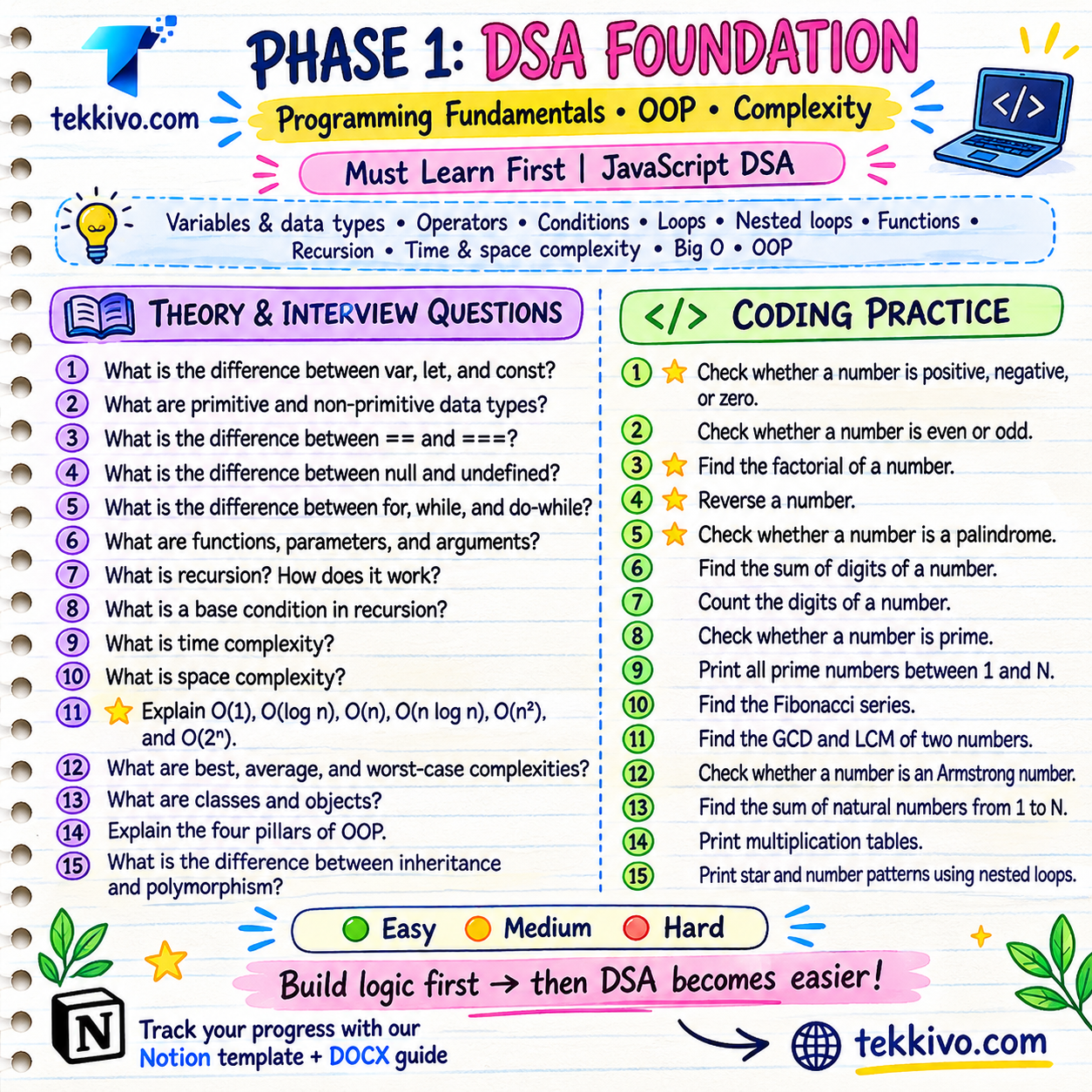
A structured DSA roadmap from Beginner to Advanced — 230+ questions across 12 phases in 5 learning sections. Each question is tagged by difficulty and interview priority. Access the full Google Doc roadmap after purchase.
$2.62$6.31
One-time payment
Planning your DSA practice?
Build a free weekly study outline based on your available time.
Open the free study plannerWhat you get
- 230+ DSA practice questions across 12 phases
- 5 structured learning sections: Foundation → Advanced DSA
- 3 difficulty levels: Easy, Medium, Hard
- ★ High-priority interview questions clearly marked
- Covers Arrays, Strings, Hashing, Two Pointers, Sliding Window, Prefix Sum
- Covers Stack, Queue, Linked List, Searching, Sorting
- Covers Recursion, Backtracking, Greedy, Trees
- Covers Graphs, Dynamic Programming, Bit Manipulation
- Access link delivered by email and in your Tekkivo account after payment
After payment, your document links are emailed to you and stay in Purchases in your Tekkivo account. This page does not unlock paid links before checkout.
Why this roadmap works
The roadmap overview describes 12 phases grouped into five learning sections. This gives you a sequence to follow, while still letting you jump to a topic you already understand.
- A 12-phase learning path grouped into five sections, as shown in the roadmap overview
- ★ High-priority interview questions clearly flagged
- Language-agnostic — works with JS, Java, Python, C++
- Downloadable TXT access guide delivered after payment confirmation
Topic preview across five learning sections
These topic cards preview the coverage. The linked roadmap organizes its full study path into 12 phases.
Topic
Loops & Functions
Loops, nested loops, functions, scope, recursion base
Topic
Complexity Analysis
Big O, time complexity, space complexity, best/worst/avg cases
Topic
Arrays
1D/2D arrays, traversal, manipulation, frequency count
Topic
Strings
String methods, palindrome, anagram, pattern matching
Topic
Hashing
Hash maps, frequency tables, collision, distinct elements
Topic
Two Pointers
Two-pointer technique, pair sum, trapping water
Topic
Sliding Window
Fixed and variable window, max/min subarray
Topic
Prefix Sum
Prefix arrays, range queries, subarray sum equals k
Topic
Stack & Queue
Stack operations, valid parentheses, monotonic stack, deque
Topic
Linked List
Singly/doubly linked lists, cycle detection, merge, reverse
Topic
Searching & Sorting
Binary search, merge sort, quick sort, sort variants
Topic
Recursion & Backtracking
Divide & conquer, permutations, subsets, N-queens
Topic
Greedy Algorithms
Activity selection, fractional knapsack, interval scheduling
Topic
Trees
BST, traversals (BFS/DFS), height, LCA, diameter
Topic
Graphs
BFS, DFS, topological sort, Dijkstra, cycle detection
Topic
Dynamic Programming
Memoization, tabulation, knapsack, LCS, LIS, coin change
Topic
Bit Manipulation
AND/OR/XOR, bit tricks, power set, single number
3 difficulty levels
Fundamentals
Build the basics right. Loop patterns, array operations, string methods, simple hashing.
Common coding rounds
Practice common patterns such as sliding windows, linked lists, binary search, and recursion.
Advanced problem-solving
Explore advanced problem-solving with backtracking, graphs, dynamic programming, and bit manipulation.
High-priority interview questions are marked with ★ throughout all three levels, so you can spot the must-know problems instantly.
Who is this for?
CS / IT students
Building a strong foundation before campus placements or internship interviews.
Self-taught developers
No CS degree but want to crack coding interviews at product companies.
Working engineers
Switching from service-based to product companies and need structured DSA prep.
Competitive programmers
Looking for complete coverage of algorithmic topics beyond easy arrays.
Bootcamp graduates
You know how to build — now you need to get past the whiteboard round.
Anyone starting fresh
Zero background. Start at Phase 1 and work through at your own pace.
Frequently asked questions
Who is this roadmap for?
Anyone starting from zero or trying to get interview-ready. It works for CS students, self-taught developers, and working engineers switching into product companies.
Which programming languages are covered?
The roadmap is language-agnostic — all problems work in JavaScript, Java, C++, and Python. You pick your language.
How is this different from LeetCode's problem list?
This roadmap proposes a topic sequence across five sections. It is a study guide, not an interactive coding platform or a replacement for solving problems in your preferred practice environment.
How do I get access after purchasing?
After Dodo Payments confirms the order, the TXT access guide is sent to your account email and appears in Purchases. It contains the roadmap document link; Google may ask you to request access according to the document owner's sharing settings.
Is this a one-time purchase?
This is a one-time payment for the downloadable TXT access guide. Access to the linked Google Doc follows the document owner's sharing settings and any updates made to that document.
What if I'm already intermediate — should I skip ahead?
You can. Each section is self-contained. If you're comfortable with arrays and strings, jump straight to Problem-solving Patterns (Phase 5).
Does it cover system design or behavioral rounds?
No. This roadmap is focused entirely on data structures and algorithms — the coding round portion of technical interviews.
Can I use this for competitive programming as well?
Absolutely. The coverage through graphs, DP, and bit manipulation covers the core competitive programming topics.